Super Smash Bros. Melee came out in 2001 and never stopped being played competitively. Twenty-odd years of a fixed ruleset has pushed the skill ceiling far past anything the game shipped with — the built-in CPUs run on scripted heuristics and are useless as practice for a serious player.
Learned bots could fill that gap, and the need is not evenly distributed. Only 16 of the top-100 ranked players are based outside the US, seven of them Canadian. Everyone else deals with visa barriers for in-person events and network latency in a game that resolves at 60 frames per second. A bot with adjustable skill — the way chess engines expose an Elo dial — would let someone improve without a local scene to practise against.
The catch is that strong Melee bots are already too strong, and in an uninteresting way. Modern hardware reacts in under 40 ms against a human threshold of roughly 200 ms, so bots win on reflexes rather than on play. Making them useful means constraining them to human reaction windows and human-like decisions, which is what pushes the problem toward learning from human demonstrations.
Does initializing reinforcement learning from professional-level imitation data produce a stronger agent than initializing from amateur-level data?
We trained two parallel pipelines to find out — one on professional tournament replays, one on Platinum-and-above ranked ladder play — and put the resulting agents against each other.
Setup
Two datasets. The professional set is tournament replay data, representing the strongest human play available. The ranked set comes from the online ladder, which tiers players Bronze through Grand Master by an Elo-style rating; we restricted it to Platinum and above so the comparison was pro against good amateur, not pro against noise.
One matchup. Fox versus Fox only. That keeps the state and action distributions tight enough to learn from a feasible amount of data, at the cost of generality — Melee has 26 characters and far more matchups than we could cover.
The problem is partially observable. We formulate play as a POMDP rather than an MDP, and the reason is deliberate: we inject input latency so the agent sees a delayed sequence of frames instead of the current one. That is what keeps it human-like, and it means the true game state has to be inferred from recent context rather than read off directly. Melee rewards exactly that kind of inference — reading momentum, combo continuation, recovery options, and an opponent's habits across frames.
- Observation — a delayed sequence of game-state features: positions, velocities, action states, frame by frame.
- State — the true game state, only partially observed.
- Action — controller outputs: movement, defensive options, attacks.
- Reward — zero-sum. Positive for dealing damage and taking stocks, negative for conceding them, with stock losses weighted above damage. Zero-sum by construction, so passive play cannot pay.
Method
We built on slippi-ai, Vlad Firoiu's framework, and ran the same two-stage pipeline on each dataset.
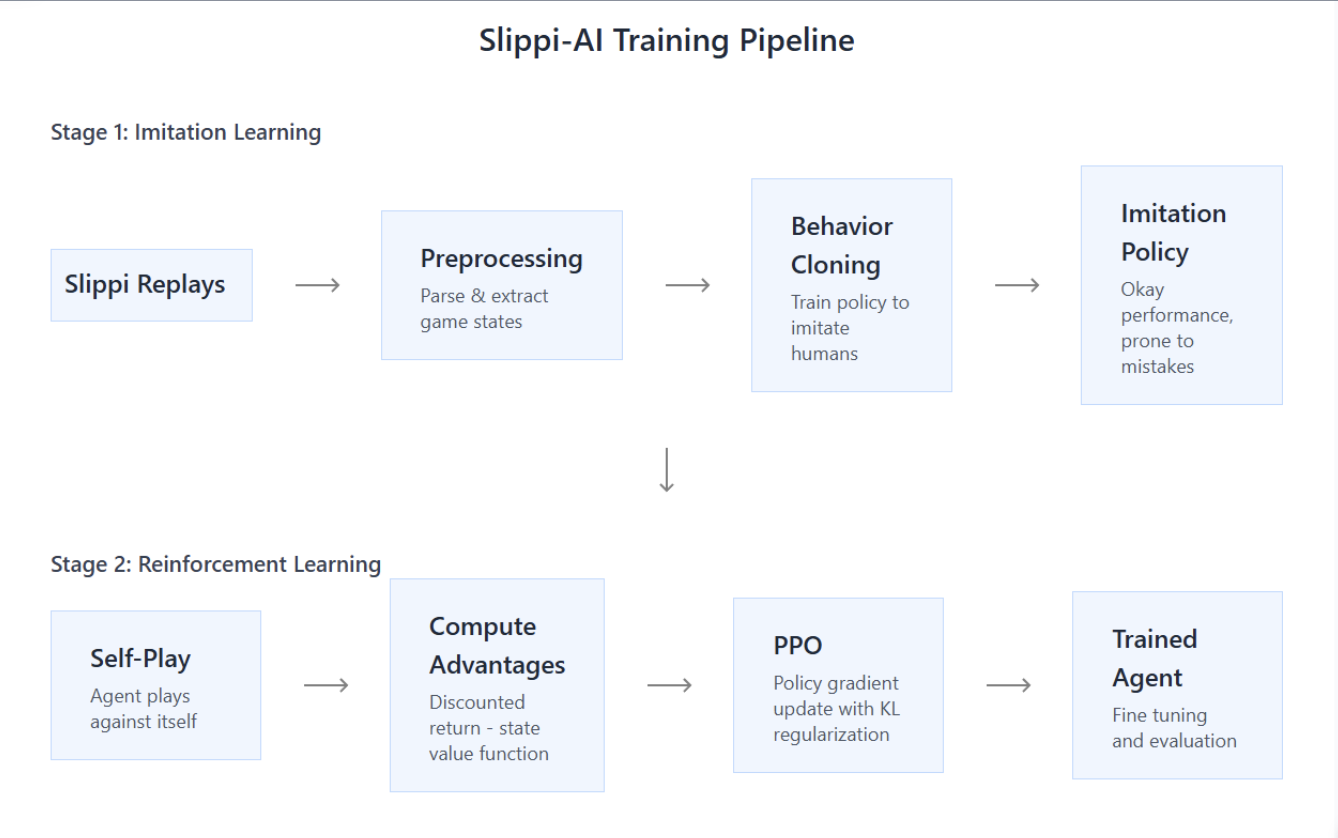
Stage 1 — behavior cloning. Supervised imitation of human inputs from replays, giving the agent a policy that already moves and presses buttons like a person before it has played a single game itself.
Stage 2 — reinforcement learning. PPO self-play initialized from that policy, letting the agent improve through interaction rather than imitation.
The split matters because it isolates the variable we care about. Both pipelines get identical architecture, identical RL, identical compute. The only difference is the skill level of the demonstrations the policy started from.
Results
Imitation learning
Both models learn fast and then plateau — loss drops sharply over the first few thousand update steps, then flattens into slow refinement.
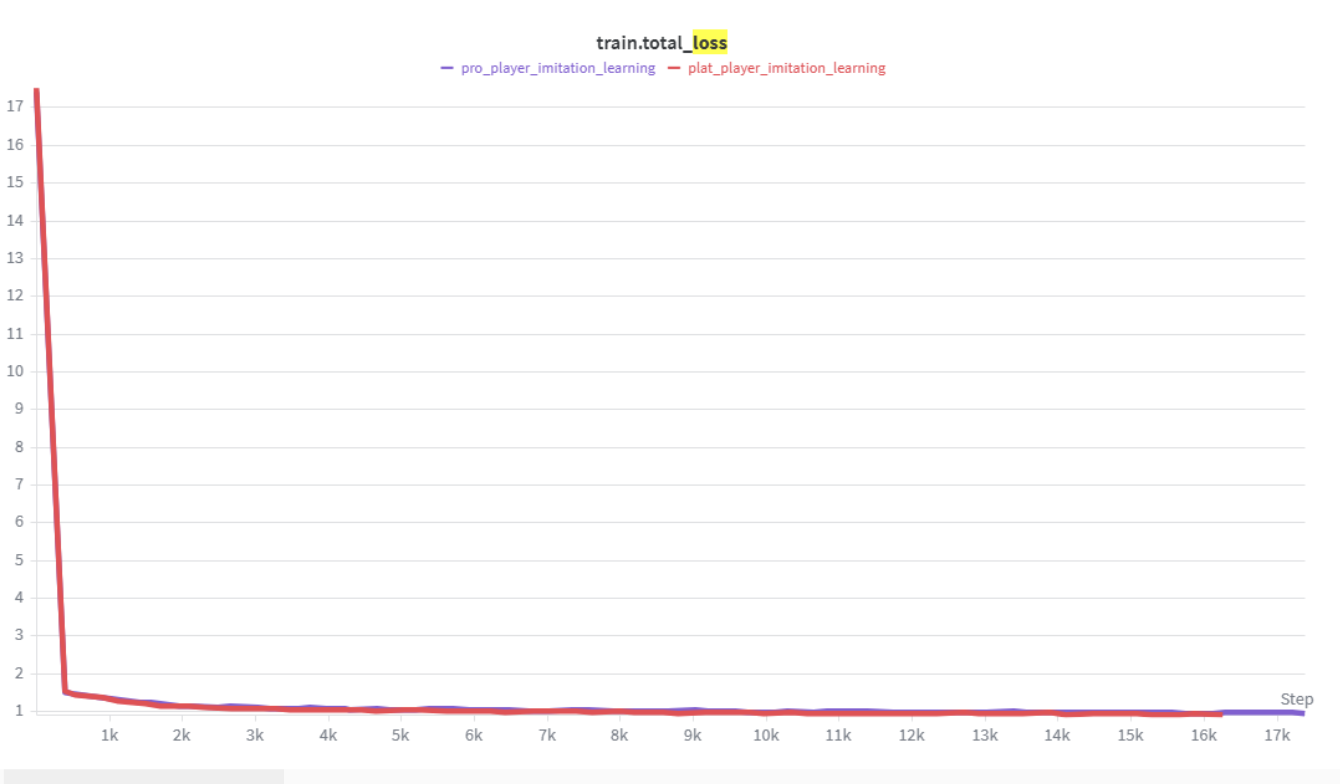
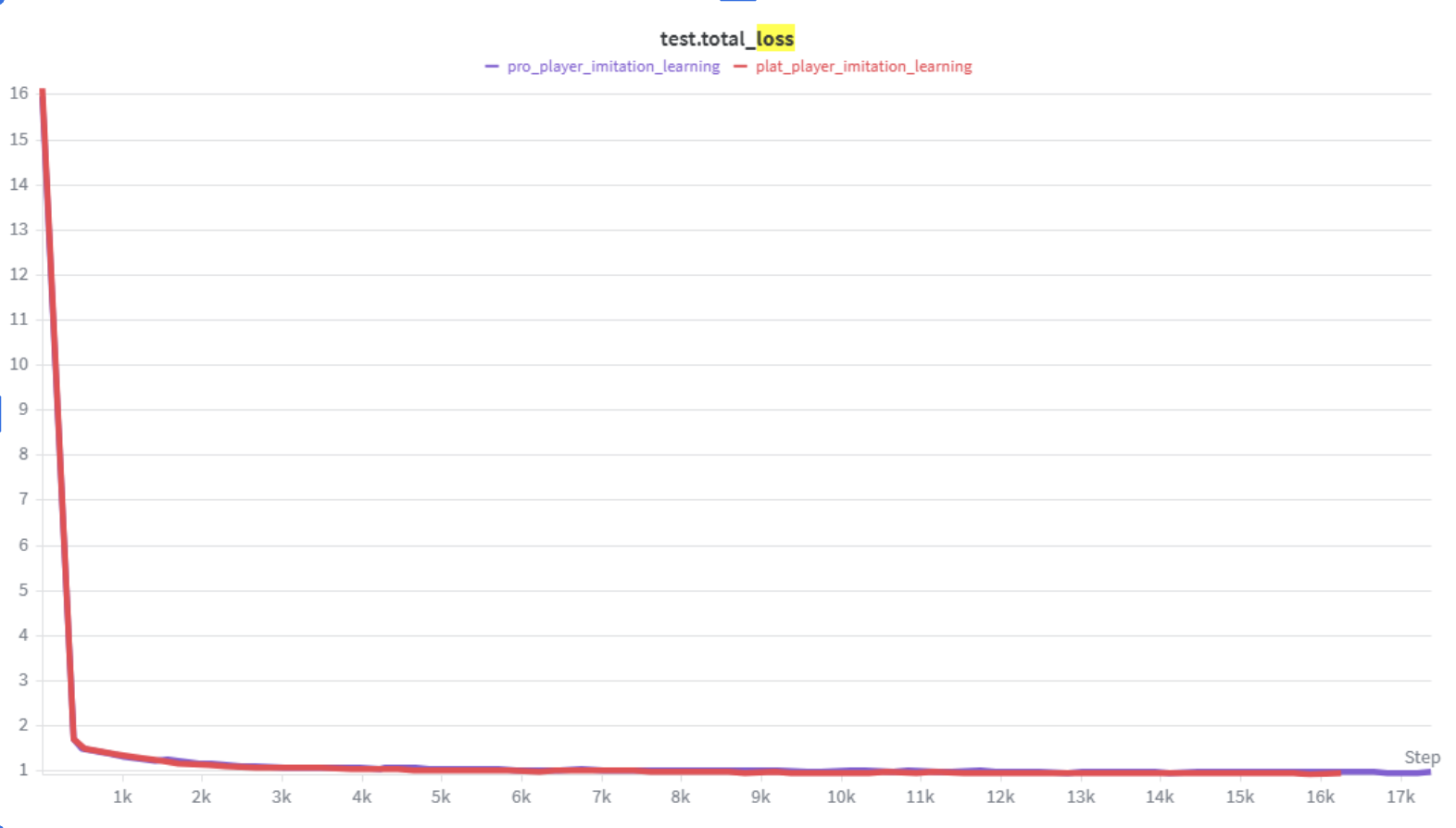
Two things stand out, and the second was not what we expected.
The train and test curves stay close together throughout, which is the reassuring result — the models generalize rather than memorize.
The professional and ranked curves also stay close together, and finish at essentially the same loss. The professional dataset did not produce lower imitation loss than the Platinum+ dataset. Going in, we assumed better demonstrations would at minimum be easier to fit or produce a visibly better clone. They were not.
What both agents shared was a ceiling. In the emulator they reproduced movement and combo inputs convincingly, but played passively — no real pressure, no KO conversions. Imitation gets you the motor skills and not the decisions.
Reinforcement learning
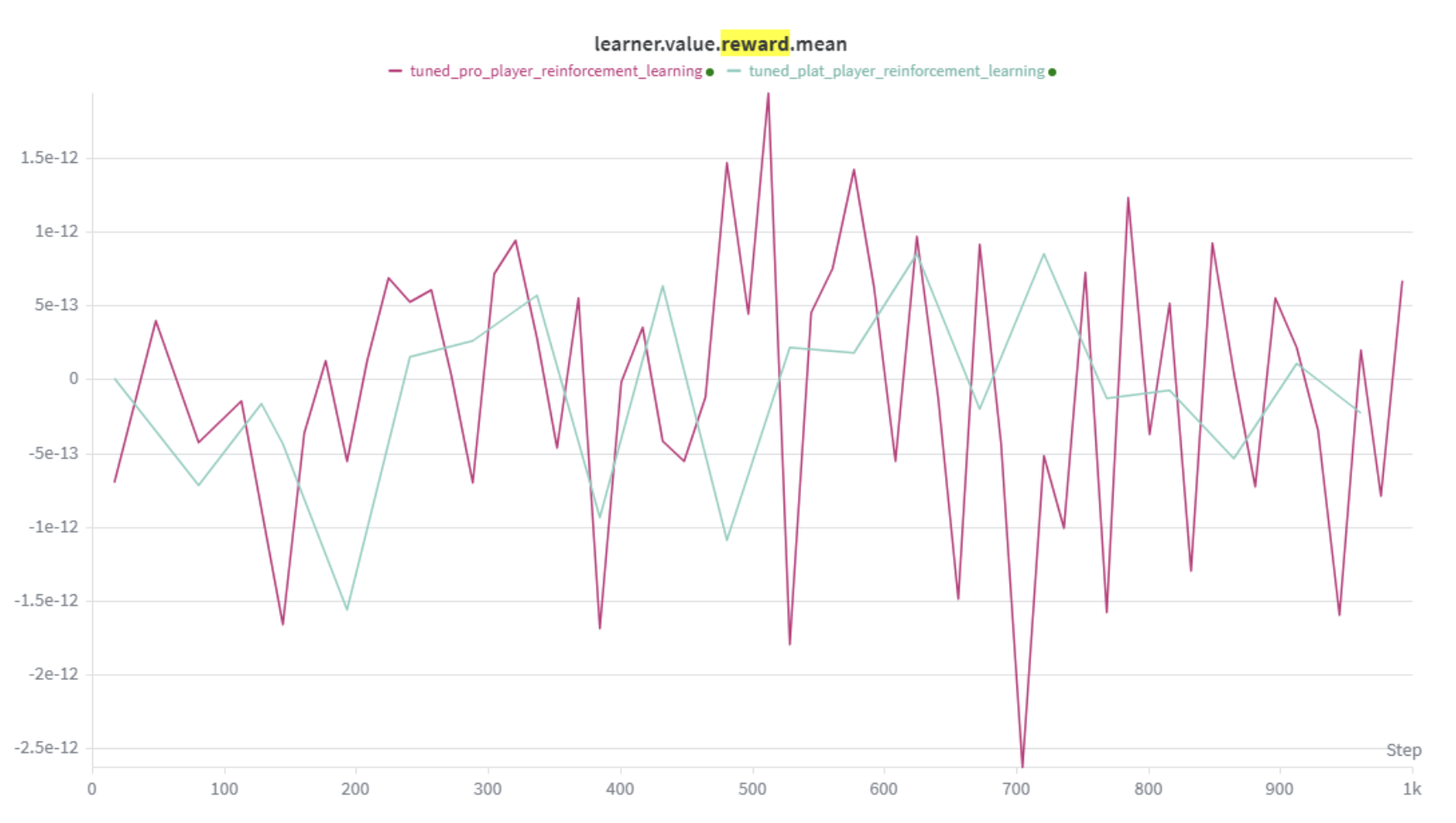
After about 10 hours of RL — roughly 80 outer steps — we ran the two agents head to head.
| Metric | Pro | Ranked |
|---|---|---|
| Final IL train loss | ~0.9 | ~0.9 |
| Final IL test loss | ~0.9 | ~0.9 |
| RL win rate | 52% | 48% |
| RL outer steps | ~80 | ~80 |
52% to 48%. Essentially a coin flip. Combined with the near-identical IL curves, the reading is that the quality of the behavioral prior had no meaningful effect — on imitation convergence or on final RL performance. Both initializations landed in the same place after the same training.
Neither reward curve trends upward, which is itself informative: 10 hours is not enough RL to open a gap. The professional agent does show slightly larger reward swings, consistent with inheriting a more varied and aggressive style from tournament play — a trace of the prior surviving into RL, even though it did not translate into wins.
The RL agents were clearly better than their BC starting points, though: more damage dealt, less damage taken, more active play in emulator evaluation.
Conclusions
The honest summary is a negative result. Professional and Platinum+ initializations converged to near-even performance, and the behavioral prior did not measurably matter.
The caveat is real and we would rather state it than bury it: the most likely explanation is simply that we did not run RL long enough. Neither reward curve had started trending upward when we stopped. A prior that looks irrelevant at 80 outer steps might separate clearly at 800. The 52–48 split is within the range you would expect from noise.
Compute was the binding constraint. RL here needs a Dolphin emulator instance per parallel environment, each on its own CPU core, so the number of instances we could run was capped by hardware rather than by design. That is the thing to fix first.
Beyond more training: a stronger evaluation setup with many more bot-versus-bot matches, so the win rate means something; extending past Fox-only to more of the 26-character roster; and comparing architectures — MLP against pure LSTM against a full Transformer — to see how much of the behaviour comes from the model rather than the data.
References
- V. Firoiu, W. F. Whitney, J. B. Tenenbaum. Beating the World's Best at Super Smash Bros. with Deep Reinforcement Learning. arXiv:1702.06230, 2017.
- V. Firoiu. slippi-ai. GitHub, 2024.
- Project Slippi. Slippi Replay File Specification. GitHub, accessed March 2026.